Places
Šibenik: The City at the Mouth of the Krka
Šibenik is where the Krka ends. The river’s drowned estuary runs down from Skradin and opens into the sea through St Anthony’s Channel, and the city climbs the hillside above the last stretch of it. Krka National Park’s own brochure calls Šibenik the oldest native Croatian city on the Adriatic, standing at the mouth of the river, and the park is run from here: its public institute has its seat on Trg Ivana Pavla II in the city.
For a visitor, Šibenik is two things at once. It is a city worth a day in its own right, the only one in Croatia with two entries on the UNESCO World Heritage List: the Cathedral of St James and St Nicholas Fortress. And it is the closest city base for the park, 15 km by road from the Lozovac entrance and 20 km from Skradin by the park’s distance table. This article covers the cathedral, the four fortresses, the old town and the channel, how the Krka lit the city, and how to get from Šibenik to the falls.
Šibenik at a glance
- Where: at the mouth of the Krka, in Šibenik-Knin County, about halfway along the Dalmatian coast between Zadar and Split.
- UNESCO: St James’s Cathedral, and St Nicholas Fortress at the entrance to St Anthony’s Channel.
- Fortresses: four, three on the hills above the old town and one at sea.
- Size: about 40,000 people today, by the tourist board’s figure.
- To the park: 15 km to Lozovac, 20 km to Skradin, 38 km to Roški slap.
- Getting there: buses from Split take about 1 hour 30 minutes and from Zadar about 1 hour 15 to 30 minutes.
A city on a river and the sea
Stand on the waterfront and the water in front of you is not quite the sea. The tourist board explains that the Krka and the Adriatic mix, with varying strength, all the way from Skradin to the Šibenik Channel, so the water around the city is brackish. Because the tides in the Adriatic are small, the lighter river water lies on top of the denser seawater, with a sharp boundary between the two layers.
That brackish water, fed by both river and sea, is why you will see shellfish farms as you sail upriver, mostly for mussels, oysters and scallops; in the Šibenik area mussels are called pidoće. Sitting on both waters also makes the city, in the tourist board’s words, a base for two national parks, Kornati at sea and Krka on the river. The geology of the estuary, a canyon drowned when the sea rose after the last glaciation, is explained in our article on the Krka waterfalls; the park measures it at a little over 22 km, from below Skradinski buk down to the fortress of St Nicholas.
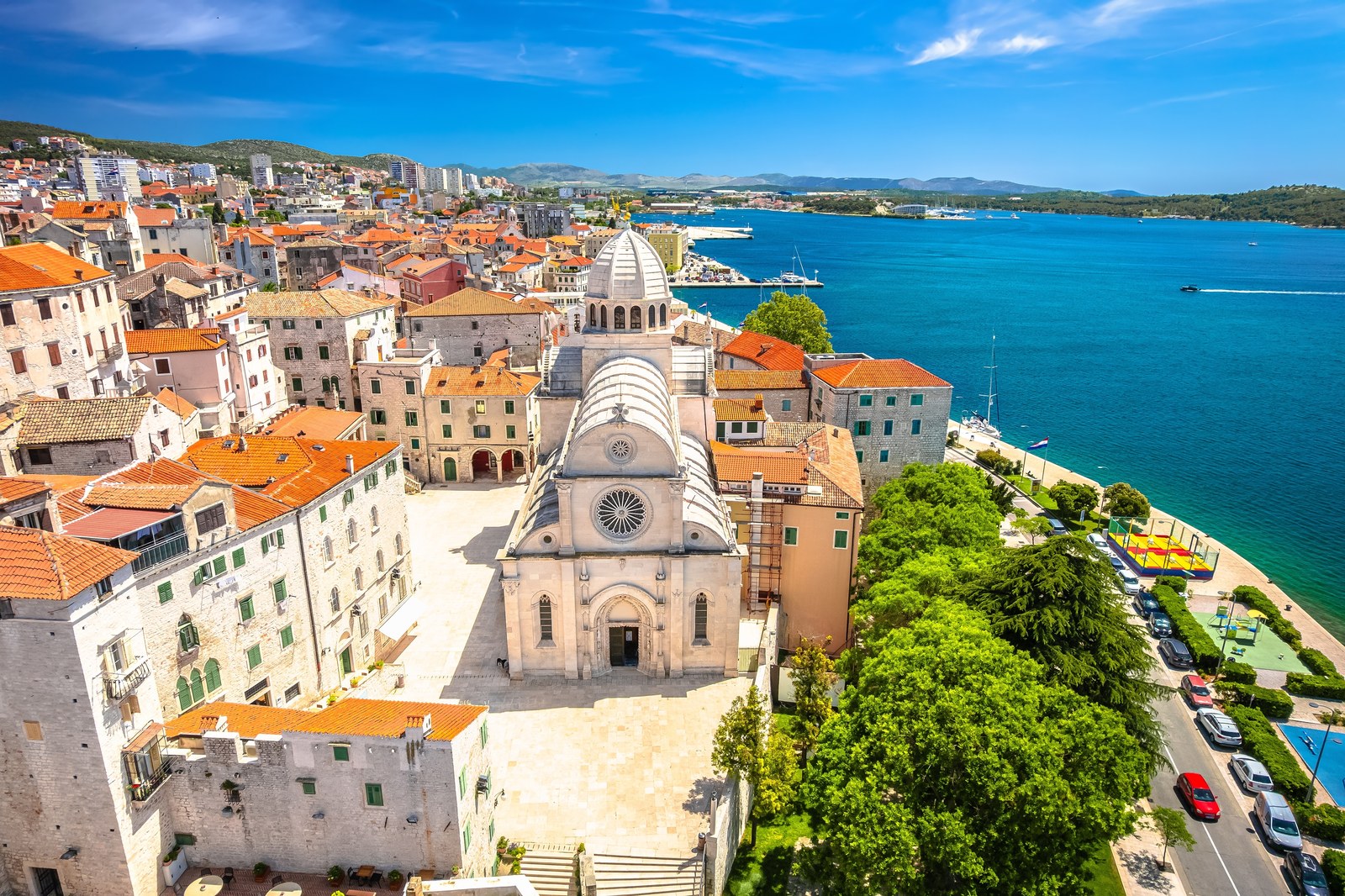
St James’s Cathedral
The cathedral is the reason most people come to Šibenik. UNESCO inscribed it on the World Heritage List in 2000 and dates it to 1431–1535; it names three architects in succession, Francesco di Giacomo, Georgius Mathei Dalmaticus and Niccolò di Giovanni Fiorentino, better known in Croatia as Juraj Dalmatinac and Nikola Firentinac. The tourist board’s account of why it was listed comes down to three things.
- Two styles in one building. It took more than a century to build, long enough for Gothic to give way to Renaissance, and the tourist board says it is where the Renaissance first appeared in Croatia, through the master builder Juraj Dalmatinac.
- The heads. Juraj added a frieze of 71 human and 3 lion heads around the outside, portraits of men, women and children of his time placed at eye level, and the baptistery deep inside the building.
- Stone and nothing else. After Juraj’s death, Nikola Firentinac finished the stone vaults and the dome. The tourist board describes it as the only cathedral built entirely of stone, from prefabricated pieces that slot into each other, with no binders, no timber and no tiled roof.
That stone roof mattered in living memory: the dome was struck during the Croatian War of Independence, and the tourist board credits the stone construction with the building’s survival. The Šibenik inventor Faust Vrančić included the cathedral in his book of inventions, Machinae novae (1615/1616), as an ornament to his homeland.
Before you go in, remember that it is a working church: the tourist board asks visitors to dress appropriately and keep quiet. The cathedral’s interpretation centre, Civitas sacra, is a 3-minute walk away on King Tomislav Street, which locals still call Kalelarga.
The old town around the cathedral
Šibenik’s old centre is larger than you might expect. The tourist board explains that in the first half of the 17th century the city had 10,000 to 12,000 people and was the largest in Dalmatia, so its historic core is bigger than those of much older Dalmatian towns. Today it has about 40,000 inhabitants.
The old town runs down a slope beneath St Michael’s Fortress, which is why the tourist board counts 2,800 stairs and says the city looks like an amphitheatre from the sea. Things to look for:
- The square in front of the cathedral, with the Renaissance city hall and the old palaces; the Prince’s Palace beside the cathedral now houses the Šibenik City Museum.
- The Square of the Four Wells, west of the cathedral, once the largest public cistern in the city; you can visit its interior.
- Over 20 sacred buildings, some still in use, others turned into galleries and museums.
- Our Lady Outside the City, facing Lujo Marun Park. In front of this church is the fountain where, the park says, a piece of Krka tufa kept growing until it was several times its original size.
Four fortresses
The tourist board calls Šibenik the city of fortresses. Three stand on the hills in and above the city; the fourth, St Nicholas, guards the entrance to St Anthony’s Channel. The three on land are run by a public institution called Fortress of Culture, and each looks out over the city, the harbour, the mouth of the Krka and the islands.
St Michael’s
The oldest, on a 70-metre cliff above the old town, takes its name from a church of St Michael that stood inside its walls from the 12th century. Fortress of Culture’s history gives the long version: Šibenik first appears in a royal charter of King Petar Krešimir IV; after a siege of 38 months the city passed to Venice in 1412; gunpowder explosions damaged the fortress in 1663 and 1752, and the Austrian administration restored much of it in 1832. Restoration began in 2012, and when it opened to visitors in 2014 it had a new open-air stage with 1,077 seats, which Fortress of Culture calls one of the most prestigious stages in the region.
Barone and St John’s
These two were built in a hurry. When war broke out between Venice and the Ottoman Empire, Šibenik’s citizens started both fortresses on 1 August 1646, with their own labour and money, and finished them in 58 days.
- Barone stands on Vidakuša, an 80-metre hill above the city. The townspeople named it after baron Christoph Martin von Degenfeld, who commanded the defence. When an Ottoman army of 25 to 30 thousand attacked in late August 1647, the fortresses held, and the army withdrew on 16 September. Today Barone is a viewpoint with food, and an augmented-reality tour with a tablet and audio guide retells the battle.
- St John’s is the highest, on a 120-metre hill north of the old town, with a northern and a southern part the tourist board calls the Pincers and the Star. Renovation began in 2016 and it opened to visitors in 2022, partly as an educational campus.
Visiting the land fortresses
In late October 2026 the Fortress of Culture’s hours page listed all three open Monday to Sunday, 9 AM to 5 PM, with last admission 30 minutes before closing. Its price list works in two seasons:
- 26 March to 31 October: an adult ticket costs €11.50 for St Michael’s and €11.50 for Barone and St John’s together, or €15 for a combined ticket to all three, which can be used once within 7 days.
- 1 November 2026 to 28 February 2027: Barone and St John’s are free, and St Michael’s stays at €11.50 for adults.
- Children up to 7 enter free all year.
The page lists no prices for early March, before the 26 March start. Hours and prices change with the season, so check before you go.
St Nicholas Fortress
The fourth fortress sits on its own at the seaward end of St Anthony’s Channel, and it is the second of Šibenik’s UNESCO sites. It was inscribed in 2017 as part of the Venetian Works of Defence between the 16th and 17th Centuries, a property of 6 components in Italy, Croatia and Montenegro spread over more than 1,000 km, and the tourist board describes it as a defensive system built to protect the city from attack by sea.
You cannot simply walk in. For now, while restoration continues, the fortress can only be visited on a boat trip run by the Public Institution Nature of Šibenik-Knin County. On the operator’s site:
- The boat leaves the Šibenik waterfront from a berth called Krka and takes about 30 minutes through the channel.
- The visit normally takes about 50 minutes, with a tour escort and multimedia guides.
- The ticket includes the boat transfer, admission to the fortress, the tour escort and the multimedia guides.
The fortress has been open to visitors since mid-June 2019. Check departures and prices before you go.
St Anthony’s Channel
The channel between the city and the open sea is protected as a significant landscape, and a walking path now runs along it, on ground that the tourist board says was closed for decades by the military. The tourist board describes the St Anthony’s Channel promenade running from Paninkovac Bay to the islet of Školjić in front of St Nicholas Fortress, about four and a half kilometres (its page gives both 4.4 km and 4.5 km), and about two hours each way on foot.
Along the way:
- A viewpoint at the highest point, looking back over the city and its fortresses.
- Bays where you can swim.
- A small pier halfway along, from which you can reach a cave with the little church of St Anthony the Hermit and the sea tunnels dug during the Second World War.
- The St Anthony’s Channel visitor centre, in a former barracks, about the life of the seabed.
The promenade ends at Školjić, but the fortress itself can currently only be reached by sea. Boat trips from Vodice to the park also sail through the channel, so you see it from the water on the way to the Krka.
The city the Krka lit
Šibenik’s link with the Krka is not only scenic. On 28 August 1895 the hydroelectric plant at Skradinski buk began supplying the city, and the tourist board says Šibenik then had the first complete system for generating, transmitting and distributing polyphase alternating current in Europe. It credits the mayor, Ante Šupuk, and the engineer Vjekoslav Meichsner, and says the plant lit the city through an 11 km line from the moment it started.
The park’s own figures and the story of the four plants on the river are in the section “Waterfalls that lit a city” of our article on the Krka waterfalls. The ruins of the original plant still stand beside the trail at Skradinski buk.
From Šibenik to Krka National Park
Šibenik is the nearest city to the falls, and you have three ways to get there.
By car. By the park’s distance table, Šibenik is 15 km from Lozovac, 20 km from Skradin, 38 km from Roški slap, 54 km from the Krka Eco Campus and 59 km from Burnum. The park’s advice is to head towards Drniš and follow the brown signs to the locality you want; for Visovac, the monastery’s directions take the D33 towards Drniš and turn off at Pakovo Selo for Miljevci. On the way, the Krnići Gornji viewpoint over the meeting of the Krka and Čikola is on the left of the road towards Pakovo Selo.
By bus. County buses leave from Šibenik bus station at Trg Draga 14, about 10 minutes’ walk from the cathedral. The park’s brochure lists the station for the lines Šibenik – Lozovac – Skradin, and on the county network line 54 runs from Šibenik to Skradin, where the park boat leaves for Skradinski buk. A new county timetable came into force on 3 September 2026, so check departures before you rely on them. Our guide to getting to Krka explains which entrance suits the bus.
By boat. Independent operators run day trips up the estuary. One speedboat trip from Šibenik runs to Skradin with the park ticket and brunch included. Only the park’s own boats sail the canyon between Skradin and the falls, so ask how the last stretch works. Our guides to Krka boat trips and Skradin cover the estuary and the town at its head.
Getting to Šibenik
- From Split: about 1 hour 30 minutes by bus; routes from Split and Zadar run daily.
- From Zadar: about 1 hour 15 to 30 minutes by bus.
- From Zagreb: about 4 to 5 hours by bus.
- By air: fly to Split or Zadar and continue by bus.
- By car: the A1 motorway has a Šibenik exit, which is also the exit for the park’s Lozovac entrance.
Šibenik as a base for the park
The case for staying in Šibenik is simple: you are 15 km from Lozovac, so you can be at Skradinski buk soon after it opens and back in town for the evening, and you have a city to explore on the day you are not at the park. The trade-offs:
- Without a car, you depend on the county bus to Skradin, or on a boat trip.
- For the middle and upper course, you still need a car: Roški slap is 38 km away and Burnum 59 km.
- For an unhurried day at the falls, Skradin, at the park gate, may suit you better; see our Skradin guide.
If you are coming from Split for the day rather than staying, our guide to Krka tours from Split compares the tours.
Frequently asked questions
How far is Šibenik from Krka National Park?
By the park’s distance table, 15 km to the Lozovac entrance and 20 km to Skradin, where the park boat leaves for Skradinski buk. Roški slap is 38 km away.
Can you get from Šibenik to Krka by bus?
Yes. County buses run from Šibenik bus station towards Lozovac and Skradin; line 54 serves Skradin. A new timetable started on 3 September 2026, so check times before you travel.
What is Šibenik known for?
St James’s Cathedral and St Nicholas Fortress, which make it the only Croatian city with two UNESCO World Heritage entries, plus its other three fortresses and its large stone old town.
How do you visit St Nicholas Fortress?
Only on the boat trip run by the Public Institution Nature of Šibenik-Knin County, from a berth called Krka on the waterfront. The crossing takes about 30 minutes and the visit about 50.
Is Šibenik a good base for Krka National Park?
Yes, especially by car: Lozovac is 15 km away. Without a car, rely on the county bus to Skradin or a boat trip, and check timetables in advance.