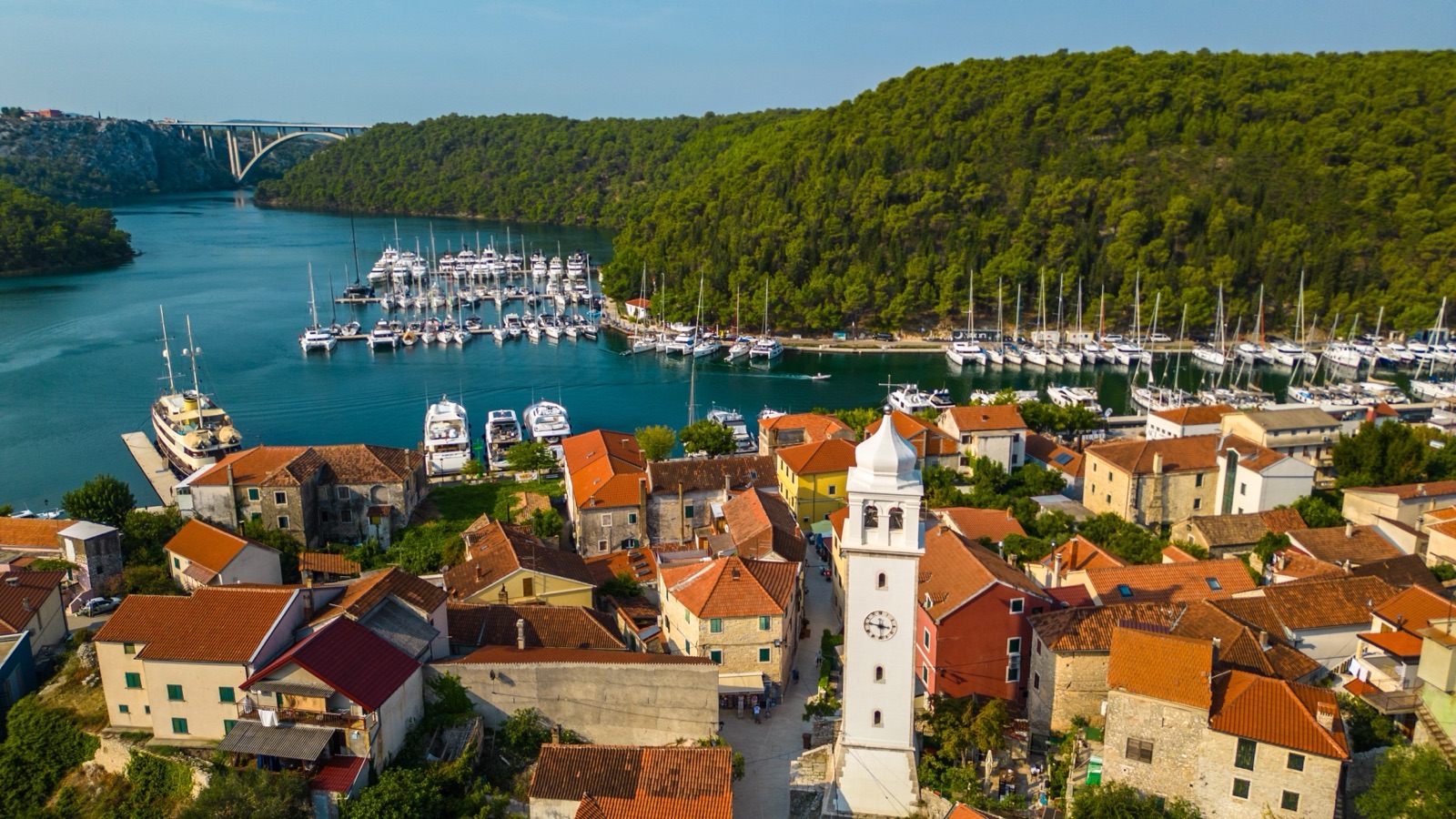
Skradin: The River Town at the Gate of Krka National Park
Skradin is the small town on the lower Krka, about 15 km from Šibenik by the tourist board’s reckoning, just below the point where the river leaves its canyon and first meets the sea. For most visitors it is the place where the park boat leaves for Skradinski buk, a 20-minute ride up the canyon that is included in the ticket from April to October. It is also a town worth an afternoon in its own right: a Roman port, a medieval seat of the Šubić princes of Bribir, an old centre protected as a cultural monument, a marina that stays open all year and a local cuisine built on eel, mussels and a risotto that cooks for most of a day.
One point surprises people: Skradin is not inside Krka National Park. Skradin Bridge, just upstream, has marked the park’s south-western boundary since 1997, and the river from the bridge to the sea, town included, has been protected separately as a significant landscape since 1968. This guide covers the town as a stop and as a base, from its history to a winter visit.
Skradin at a glance
- Where: on the lower Krka, about 15 km from Šibenik; by the park’s road table, 20 km from Šibenik, 28 km from Vodice, 61 km from Trogir, 76 km from Zadar and 94 km from Split.
- Into the park: the park boat to Skradinski buk, April to October, 20 minutes; or the 3,400 m trail from Skradin Bridge, on foot or by bike, all year.
- Parking: privately run and charged in town; about 10 free spaces near Skradin Bridge.
- By water: ACI Marina Skradin, in the town centre, open all year round with 180 berths.
- To eat: Skradin risotto, Skradin cake, eel and brackish-water fish.
- Bags: a luggage storage in town; the park has none.
From Scardona to Skradin
The town’s history can be traced back to Illyrian times. Its name, the town’s tourist board explains, comes from the root skard, meaning steep, rock or cliff, and the ending of the original name, Scardona, points to a settlement older than the Romans and even than the Liburnians. Ancient writers knew it: the name is attested in Strabo and Procopius, Pliny the Elder and Ptolemy.
For the Liburnians, the seafaring people of this coast, Scardona was one of the most important cities, the seat of a conventus iuridicus, a court district. Under Rome it became a municipium, a port and a garrison town, and an important centre of trade:
- The river road inland. The Krka, which the Romans called Titius, had been one of the main routes from the eastern Adriatic coast into the interior since prehistoric times.
- Burnum’s port. At the beginning of the 1st century Scardona became the main transit port for the Roman military camp at Burnum, upriver. The remains of the port and its buildings stretch for about 700 metres.
- The boom years. The town was at the height of its power in the first two centuries AD, when temples and public buildings went up and immigrants, mainly from Italy, came to trade.
The town had a bishop as early as the 6th century. Destroyed in the 7th century, during the attacks of the Slavic tribes, it was restored by the Croats, who named it Skradin, and under that name it was first mentioned in the 10th century, as the seat of a bishop.
The Šubić town and the Ottoman centuries
In the late 13th century Skradin became one of the seats of the House of Šubić, the princes of Bribir, who gave the town its charter. The Turina fortress on the hill above the town was built on the remains of a prehistoric hill-fort in the time of Pavao Šubić I, who ruled from 1273 to 1312. Wikipedia describes Skradin in the late 13th and early 14th centuries as the capital of the Šubić bans Paul I and Mladen II, who raised the settlement below the fortress to a free commune with its own statute.
The town’s position made it a prize, and the tourist board says Avars, Turks and Venetians all ravaged it at different times. The Ottomans took Skradin in 1522 and held it, with a few interruptions, until October 1683, when uskoks from Venetian Dalmatia rose up and seized the town; the Venetians finally took it in 1684. So the Ottoman period runs to 1683 in the tourist board’s dates and to 1684 in Wikipedia’s. Under Venice the town recovered, and the houses of the old centre date from the 18th and 19th centuries.
Walking the old town
The whole town centre is a protected cultural monument. Its plan is simple: one long main street with side streets running off it at right angles, paved lanes, passages and archways, and houses with colourful façades in the Venetian manner, built in the 18th and 19th centuries.
What to look for:
- Mala Gospa Square. The south end of the main street opens into the square, with the parish church, the rectory and the town hall.
- The church of the Nativity of the Blessed Virgin Mary. A single-nave church in Late Baroque and Classicist style, built on the ruins of a mosque that the Ottoman authorities had raised on the foundations of an earlier, pre-Romanesque church. The Venetian Republic largely paid for it, and it was consecrated on 16 April 1758. Its organ, installed in 1776, comes from the Nakić school and was built by the Italian organ builder Francesco Dacci.
- The bell tower. Built in 1872, because of its weight it was put not beside the church, which stands on soft, marshy ground, but on the nearest cliff, about 60 m away. Look for the slanted base and the onion dome.
- The parish and abbey rectory, often called the finest building in town: a treasury of 17th- and 18th-century paintings, brocade vestments, chalices, reliquaries and monstrances.
- St Jerome’s. Outside the town near the shore, a 16th-century church destroyed by the Ottomans and rebuilt a century later, beside a cemetery that was once a convent of the Poor Clares.
- St Spyridon’s. The Orthodox church, built in 1876 in Neo-Gothic style with money largely from the Austrian government and Emperor Franz Joseph I. It has an 18th-century iconostasis by Rapsomanikis of Corfu.
- St Paraskeva’s. A second Orthodox church, from 1895, on the hill west of the town.
- Turina. The remains of the Šubić fortress, on the hill above it all.
Into the park from Skradin
Skradin is the park’s entrance by water, and the way in is simple: from April to October park boats run from Skradin to Skradinski buk during park hours, and the ride takes about 20 minutes. Buy your ticket at the park office in town before you board, or show an online ticket at the boat. The office opens half an hour before Skradinski buk opens.
The ticket covers each locality once, so if you go up by boat, you come back by boat. And only the park’s own boats sail the canyon above Skradin, so a private boat from the coast stops here. Our guides to getting to Krka and Krka boat trips cover the entrances, the boat and the excursions upriver, and the park map guide shows how they fit together.
The trail from Skradin Bridge
If you would rather walk or cycle, a 3,400 m trail runs from Skradin Bridge up the right bank of the river to Skradinski buk. It is the way in from Skradin in winter, when the boat does not run. The practical points:
- Start: at the park reception at Skradin Bridge, which sells tickets for the trail.
- Parking: about 10 free spaces near the bridge; otherwise park in town, 10 to 20 minutes from the start of the trail.
- Surface: gravel and earth, shared by walkers and cyclists. It begins with a long, gentle descent towards the river and has speed bumps near the end.
- Bikes: leave them at the marked place by the reception at the falls. Bicycles are not allowed on the boat to Skradin, so if you cycle in, you cycle out; the park measures the ride from the town of Skradin to the falls and back, rather than from the bridge, at 8.6 km, the shortest cycling trail in the park.
The trail has its own history. Today’s blue bridge was built in 1953. In 1927 the river crossing between Šibenik and Skradin was a pontoon bridge; a trestle bridge built in 1930 was destroyed by the German army in the Second World War. Just above the bridge, the park says, is where the Krka first meets the sea. On the way you pass Macelinuša, the largest island on the Krka, and walk the old route along which carts once hauled corn, barley and wheat to the mills at Skradinski buk, while boats from all over Dalmatia filled the canyon to carry the flour away.
Parking and arriving by car
Take the Skradin exit off the A1; the park says it is five to ten minutes from either of its motorway exits to an entrance. In town:
- Parking is private and charged. The park’s own parking at its other entrances is free, but Skradin’s is not run by the park.
- The bridge car park is free but has room for only about 10 cars.
- If you only want the falls, Lozovac may suit you better: free parking all year and a park bus down to Skradinski buk from April to October.
Getting here from Split, Šibenik and Zadar
Without a car, Skradin is the easier entrance: the park’s brochure says regular bus lines run from Split and Zadar to Šibenik and to Skradin, on a seasonal timetable that you should check before travelling.
- From Šibenik: county bus line 54 runs from Šibenik to Skradin. A new county timetable came into force on 3 September 2026, so check current departures.
- From Split and Zadar: a regular bus to Šibenik or straight to Skradin. Split is 94 km away by road, Zadar 76 km.
- By tour: Split tours that use the boat from Skradin include the Skradin tour on our tours page, and some coach days finish here after coming in at Lozovac. Our comparison of Krka tours explains which do what.
- By sea: boat trips from Vodice and Šibenik sail up the estuary to Skradin.
The marina and arriving by boat
ACI Marina Skradin sits in the centre of town, on Obala Pavla Šubića, and is open all year round. It has 180 berths and takes vessels up to 70 m on a daily berth. Its position at the entrance to the park, says the tourist board, makes Skradin one of the most important nautical destinations in the Adriatic.
The approach is part of the appeal. From the Šibenik Channel the course follows the Krka and the Prukljan strait, marked by red and green lights; the marina’s own notes say the riverbed narrows to 100 m and later to 80 m, and that boats customarily keep to the starboard side. On the way you cross Lake Prokljan, four kilometres downstream of the town: Croatia’s second-largest lake at 11.5 square kilometres, a drowned river valley formed about 10,000 years ago, with 153 bird species recorded around it. The tourist board tells the legend of the islet of Stipanac, where a cruel lord called Gavan is said to have sunk to the bottom of the lake with his castle.
Day-trip boats from the coast tie up here too.
What to eat in Skradin
The tourist board describes Skradin’s cooking as a blend of Dalmatian and inland traditions, with dishes it says are hardly found anywhere except around Skradin and Lake Prokljan:
- Skradin risotto. The town’s signature, which Anthony Bourdain featured on his TV show No Reservations. It takes between 8 and 10 hours to prepare and is traditionally made by the men of Skradin; another of the board’s pages says eight, nine and sometimes eleven hours. With that cooking time, ask a restaurant ahead whether it is on.
- Skradin cake (skradinska torta). Almonds, walnuts and honey, made for centuries and served as a sign of welcome with a glass of rose liqueur.
- Eel and small fish. Cold eel (bijod) with polenta made from corn milled at the Skradinski buk mills, and fried čokalice, small fish that live in the brackish layer of the river.
- From the hinterland: koprtlje, an archaic dish of prosciutto and pancetta wrapped in lamb and cooked with dried meat; local sausages; and dishes under the peka baking lid.
- Seafood. Šibenik Bay and Zaton Bay are among the best-known mussel-breeding places on the Dalmatian coast, thanks to brackish water where the sea meets Lake Prokljan, springs and the Krka. Mussels buzara, roasted fish, brodetto and seafood risotto are the coastal staples.
- Sweets to take home: candied bruštulani almonds and sweets made from dried figs and mulberries.
Where to stay
The county tourist board lists the hotel Skradinski buk, pensions, apartments and private rooms. Why stay here rather than on the coast:
- The first boat. From April to mid-October Skradinski buk opens at 8:00, and the park office in Skradin opens half an hour earlier. Sleeping in town puts you on an early boat without a drive.
- Bags. Skradin Luggage Storage, on Skradinskih svilara, is listed as open every day from 07:00 to 22:00, useful if you are moving between bases, since the park has no luggage storage of its own. Check before you go.
If you would rather stay on the coast, Šibenik is about 15 km away.
A day planned from Skradin
Morning at the falls. Take an early park boat to Skradinski buk and walk the 1,900 m circuit; the park’s ticket shop allows 2 hours. In high season, go early: the park’s FAQ says summer brings the most visitors.
Optional: upriver by boat. From the dock above the falls, the 4-hour excursion to Roški slap via Visovac costs an adult €20 on the 2026 price list, and the 2-hour Visovac trip €15. Both are booked on the day at the dock.
Back to Skradin by boat. Remember the ticket rule: once you leave Skradinski buk you cannot go back on the same ticket, so do not plan to pop down to town for lunch and return to the falls.
Afternoon in town. The old centre, the bell tower, St Spyridon’s and the climb to Turina.
With a car, further afield:
- Bribirska glavica, in Bribir 15 km from Skradin: the centre of the Croatian state in the 13th century, a site of about 72,000 square metres at 300 m above sea level, known among archaeologists as the Croatian Troy. St Nicholas Tavelić, the first Croatian saint, joined the Franciscans in its monastery in 1375.
- Lake Prokljan, downstream, and the mouth of the Guduća river on its north-western shore.
- Cycling: the tourist board counts five trails in the wider Skradin area, to Bribirska glavica, Skradinski buk, the Čikola canyon and Prokljan.
Skradin in winter
From November to March Skradin changes. The park boat to Skradinski buk does not run, and from town the only way to the falls is the trail from Skradin Bridge, on foot or by bike. The alternative is to drive round to Lozovac, where in winter you may take your own car down the 4 km road.
What winter gives you in exchange:
- A €7 ticket for an adult, on the 2026 list, against €40 in summer.
- The most water. The Krka runs highest in November and March, and the park’s FAQ says winter is when the abundance of water and the travertine shapes are easiest to see.
- An open marina. ACI Marina Skradin stays open all year round.
What to watch:
- Short days. Skradinski buk is open 9:00 to 16:00 from November to February and to 17:00 in March.
- Holidays. On 1 January only the Lozovac entrance opens, so the park’s Skradin entrance is closed. On 24 and 31 December the park is open 9:00 to 12:00, and it is closed on 25 and 26 December.
Check hours before you go. Our guide to tickets, hours and trails has the full timetable.
Frequently asked questions
Is Skradin in Krka National Park?
No. Skradin Bridge has marked the park’s south-western boundary since 1997, and the town lies below it, on a stretch of river protected separately since 1968. The park has an office in Skradin, and its boats leave from the town.
How do you get from Skradin to the Krka waterfalls?
By park boat from April to October, a 20-minute ride included in the ticket. All year you can walk or cycle the 3,400 m trail from Skradin Bridge to Skradinski buk.
Is parking free in Skradin?
No. Parking in town is private and charged; there are about 10 free spaces near Skradin Bridge, and Lozovac has free parking.
How far is Skradin from Split?
94 km by road on the park’s table, via the Skradin exit of the A1. Regular buses also run from Split and Zadar to Skradin; check the seasonal timetable.
What is Skradin risotto?
The town’s signature dish, slow-cooked for 8 to 10 hours and traditionally made by the men of Skradin. Ask ahead, given the cooking time.
Does the boat from Skradin run in winter?
No. From November to March you reach Skradinski buk from Skradin on the trail from Skradin Bridge, or you drive to Lozovac and take the road down in your own car.