Places
Krka or Plitvice: Which Croatian Waterfall Park Should You Visit?
Krka and Plitvice are Croatia’s two great waterfall parks, and both were built by the same process: tufa, or travertine, deposited by hard karst water until it forms barriers, lakes and falls. But they are very different days out. Krka is a river park close to the Dalmatian coast, 109 km² along the Krka River near Šibenik, with its main waterfall about an hour’s drive from Split. Plitvice is a chain of sixteen named lakes in the mountains of Lika, inland and roughly halfway between Zagreb and Zadar; it is Croatia’s oldest and largest national park, just under 300 km², and a UNESCO World Heritage Site since 1979.
The short answer: if you are staying in Split, Trogir, Šibenik or Vodice and have one free day, go to Krka. If you are travelling between Zagreb and Zadar, want a full day of walking among lakes, or simply want the bigger spectacle and can spare the travel time, go to Plitvice. If you have two days, do both, on separate days. The rest of this article explains why.
The short answer
- Choose Krka if you are based on the central Dalmatian coast, want a half day or a relaxed full day, like boat trips and history as well as waterfalls, or want a summer swim in a designated spot.
- Choose Plitvice if you are driving between Zagreb and the coast, want a long walk on boardwalks through a whole system of lakes, or are staying in Zadar or inland.
- Do both if you have two days. They are too far apart, and Plitvice is too big, to combine sensibly in one.
Same stone, two landscapes
Both parks exist because of tufa. Plitvice was inscribed on the UNESCO list on 26 October 1979 precisely for the process of tufa formation that built its lakes. Krka’s park calls tufa the river’s defining phenomenon. The difference is in what the tufa has made.
Plitvice is a staircase of lakes. Sixteen named lakes and several smaller ones cascade one into the next. The twelve Upper Lakes sit on dolomite, with gentler, wooded shores; the four Lower Lakes lie in a deep limestone canyon with steep cliffs. The water changes colour from lake to lake, from emerald green to deep blue. Yet the lakes cover just under 1% of the park; the rest is forest and grassland. The park adds that its largest lake, Kozjak, was still two separate lakes approximately 400 years ago, a reminder that the barriers are still moving.
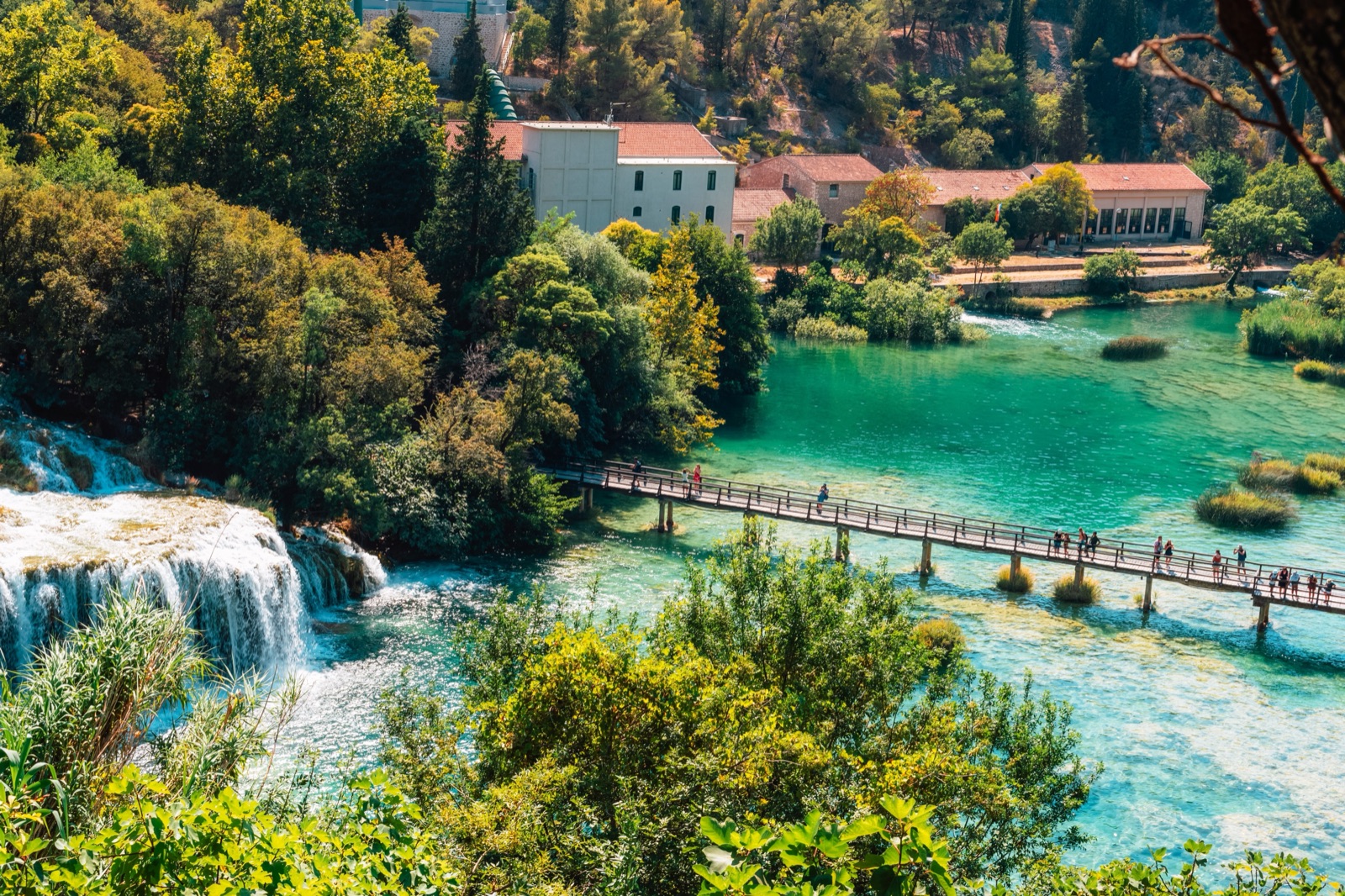
Krka is a river with waterfalls. It runs about 72.5 km from near Knin to the sea at Šibenik, dropping 224 m over seven tufa waterfalls with long, calm, lake-like stretches between them. Its famous fall, Skradinski buk, is a broad barrier of seventeen steps spread along 800 m, with a total drop of 45.7 m, which the park calls the longest tufa barrier in Europe. Our article on the Krka waterfalls goes through all seven.
Both systems are old and still young at once. Plitvice has tufa barriers 250,000 to 300,000 years old lying outside its present watercourses, evidence of how far the lakes have shifted. At Krka, fossil tufa sits up to 20 m above today’s riverbed, while most of the tufa on the falls themselves is younger than 10,000 years. In both parks the barriers are still growing, which is why both ban swimming at their main falls and keep visitors on the trails.
In practice that means Plitvice is about lakes, seen from wooden walkways over the water, while Krka is about one great cascade, a river to travel along, and what people built beside it.
Size and layout
On paper Plitvice is nearly three times the size of Krka: just under 300 km² against 109 km². What matters more on the day is how the sights are arranged.
At Plitvice the lakes form one compact visitor zone with two main entrances, about 3 km apart, linked by trails, an electric boat across Kozjak and panoramic vehicles. Everything you come for is within that zone, and the routes are circular.
At Krka the sights are strung out along the river. Skradinski buk is a self-contained loop reached from the Lozovac or Skradin entrance. Roški slap, the monastery island of Visovac and the upper falls lie further upstream, reached by park boats or by road. Frank About Croatia, an independent travel guide, puts it plainly: Krka’s sights are in separate places, and you need a car (or the park boats) to link them.
Getting there from the coast
Here Krka has the clear advantage for anyone on the Dalmatian coast.
| From | Krka (Lozovac entrance) | Plitvice |
|---|---|---|
| Split | 89 km in the park’s distance table; about an hour by car | Less than 3 hours by car |
| Zadar | 81 km to Lozovac, 76 km to Skradin | A bit less than 2 hours by car |
The Krka distances come from the park’s own brochure, which also puts Lozovac just 15 km from Šibenik; the drive times are Frank About Croatia’s. For Plitvice by bus, sources differ: one independent Plitvice guide gives 3 to 4 hours from Split and 2 to 3 hours from Zadar, while Frank About Croatia puts Split at about 4h 30 min. Plitvice is reached on state roads from the Zagreb and Zadar direction, and its bus stops serve both directions.
For Krka, the route depends on which entrance you use; our guide to getting to Krka covers the car, bus, tour and boat options from Split, Šibenik and Zadar.
How much time each needs
Plitvice sets out its visit as lettered programmes, colour-coded from each entrance. A selection:
- Programme A: 2 to 3 hours, 3,500 m, from Entrance 1, taking in the Great Waterfall and the Lower Lakes canyon.
- Programme C: 4 to 5 hours, 8,000 m, covering both the Lower and Upper Lakes, mostly returning by panoramic vehicle.
- Programme H: 4 to 6 hours, 8,900 m, from Entrance 2, covering the whole lake area.
- Programmes K1 and K2: 6 to 8 hours, almost entirely on foot.
Add the drive from Split, and Plitvice is a full and long day. That is why many visitors stay overnight: guests of the park’s Hotel Jezero and the Korana and Borje campsites pay for the first day only and enter free on the days after.
Krka is quicker. Frank About Croatia reckons visitors spend 2 to 3 hours at Skradinski buk on average, and suggests allowing a minimum of 7 to 8 hours for a full day, including lunch. The park’s own boat excursions add to that: Skradinski buk to Visovac and back takes two hours, and the trip on to Roški slap four hours. A morning at Skradinski buk from Split or Šibenik, back by mid-afternoon, is entirely realistic.
The waterfalls compared
If height is what you are after, Plitvice wins. Its Great Waterfall, where the Plitvica stream drops into the Lower Lakes canyon, falls 62 m, and the park gives a total height of 87 m down to the Korana River, making it the highest waterfall in Croatia. The Upper Lakes add the falls of Veliki and Mali Prštavac and countless small cascades between the lakes.
Krka’s best-known fall is a different kind of sight. Skradinski buk is wide rather than tall, a long, many-stepped barrier of white water, pools and islets, with restored watermills and the ruins of an 1895 hydroelectric plant along its trail. Roški slap, upstream, opens with a run of small cascades called the Necklaces. Krka’s tallest fall, Manojlovac, at 59.6 m, rivals Plitvice’s, but it lies far up the canyon and is seen from a viewpoint, so few day visitors reach it.
Walking, boats and trains
Both parks are walked on marked trails and boardwalks, and both expect you to stay on them.
- At Plitvice the ticket includes the electric boat and the panorama train within your chosen programme, and covers 22 km of trails around the lakes plus 36 km of hiking trails.
- At Krka the ticket includes the boat from Skradin to Skradinski buk and the bus from Lozovac, both from 1 April to 31 October. The park’s excursions on to Visovac and Roški slap cost extra and can only be booked on site; in 2026 the two-hour Visovac trip costs €15.
Krka’s boats sail in stages, because the tufa barriers block the river. That makes a Krka day feel like a journey along a river, while Plitvice feels like a circuit around a valley of lakes.
Tickets by season
Both parks charge by season, and in 2026 their peak prices are identical.
| Season (2026) | Krka, adult, all land sites | Plitvice, adult day ticket |
|---|---|---|
| January to March, November and December | €7 | €10 |
| April, May and October | €20 | €23 |
| June to September | €40 (€30 after 15:00) | €40 (€25 after 4 p.m. in June to August, after 3 p.m. in September) |
For children aged 7 to 18, Krka charges €4, €12 or €15 by season, and Plitvice €4, €6 or €15 (€9 later in the day in summer). Children under 7 go free at both. Plitvice also sells a two-day ticket, from €15 in winter to €60 in summer. At Krka, one ticket covers a single visit to every land locality on the same day, and there is a cheaper ticket for Roški slap and the upper sites that leaves out Skradinski buk; our guide to Krka tickets and trails explains the options.
These are the prices in each park’s 2026 price list. Both parks reserve the right to change them, so check before you go.
Crowds and booking
Both parks are at their busiest in summer, and both handle it differently.
- Plitvice encourages visitors to buy tickets online in advance. An online ticket must be validated at the entrance you chose when buying, within the time window you booked, and tickets at the gates are sold only if the day has not sold out. Frank About Croatia suggests arriving early in the morning or in the late afternoon to avoid the summer crowds.
- Krka sells park tickets at its entrances and online, but its boat excursions to Visovac and Roški slap can only be booked on site, on the day. The park notes that summer brings the highest visitor numbers, and the 2026 price list makes a late arrival cheaper: from June to September the adult ticket drops to €30 after 15:00.
At either park, an early start is the simplest way to see the falls with fewer people on the boardwalks.
Can you swim?
Not at the famous falls of either park. At Plitvice, swimming in the lakes is strictly prohibited. At Krka, swimming at Skradinski buk is not allowed, so photos of bathers below the falls do not reflect today’s rules. Krka does allow swimming in designated areas at Roški slap, Stinice and Pisak, from 1 June to 30 September, at your own risk and depending on the weather and water level. Jumping off the falls or bridges is prohibited.
If a swim matters, Krka is the only one of the two that offers it, and only in summer and away from Skradinski buk.
Seasons and opening
Both parks are open all year, but winter changes them.
- Plitvice in winter: the Lower Lakes are usually open and the Upper Lakes closed, usually reopening in early April. The park says the Great Waterfall is at its best in spring and autumn, and that in cold winters it sometimes freezes. In October 2026 its hours page listed the entrances open from 07:00 to 18:00, with ticket sales until 15:00.
- Krka in winter: the boats and the Lozovac bus run from 1 April to 31 October only. The park says winter is when the abundance of water and the shapes of the tufa are best seen; the river is at its highest in November and March and its lowest in August.
- Summer brings the highest prices at both parks, and at Krka the most visitors and the lowest water.
For a quieter visit with the falls in good flow, spring and autumn suit both parks.
History along the way
Plitvice is above all a natural landscape. It was proclaimed Croatia’s first national park on 8 April 1949, and its boundaries were expanded in 1997.
Krka, declared a national park on 24 January 1985, mixes nature with layers of history. Franciscan friars have lived on Visovac since about 1445. The Romans built a military camp at Burnum to guard the river crossing. Restored watermills line the falls, and the 1895 power plant at Skradinski buk was among the first anywhere to supply alternating current to light a city. If you like a day with a monastery, a museum and a boat trip as well as waterfalls, Krka gives you more of it.
Which should you choose?
- Staying in Split or Trogir, one free day: Krka. It is about an hour away by car, and tours run from both.
- Staying in Šibenik or Vodice: Krka, comfortably in half a day.
- Driving between Zagreb and the coast: Plitvice, on the way, ideally with a night nearby.
- Staying in Zadar: either. Krka’s Skradin entrance is 76 km away; Plitvice is a bit less than 2 hours by car.
- Want lakes and a long walk: Plitvice.
- Want a boat trip, an island monastery and a summer swim: Krka.
- Travelling in winter: both stay open, but Plitvice’s Upper Lakes usually close and Krka’s boats stop running.
Dogs, children and mobility
- Dogs: both parks admit dogs on a leash, including on Plitvice’s boats and trains. Dogs are not permitted on Krka’s island of Visovac.
- Children: under 7s go free at both. Plitvice’s shortest programme is a 3,500 m circuit; Krka’s loop around Skradinski buk is 1,900 m, with mills and boardwalks to break it up.
- Mobility: Plitvice says its lakeside trails do not allow wheelchair access throughout, and staff at the entrance recommend the most accessible route. Krka publishes a separate page on visiting with reduced mobility for each main locality. Ask either park before you travel.
Doing both
The two parks reward separate days. Plitvice works best with a night nearby, so a common pattern is Krka as a day trip from the coast, then Plitvice on the road north towards Zagreb, or on a day out from Zadar. One Plitvice guide notes a regular daily bus from Skradin to Plitvice; timetables change, so check it before you rely on it.
A two-day plan from Split might look like this:
- Day one: Krka. Skradinski buk in the morning, then, from April to October, the park boat to Visovac, back on the coast by evening.
- Day two: Plitvice by car or tour, with an early start, walking one of the longer programmes such as C or H.
From Zadar the order hardly matters; from Zagreb, see Plitvice first and continue to the coast.
Coach tours run to both parks from Split and Zadar. For Krka, the tours page lists day trips from Split, Trogir and Zadar and boat trips from Šibenik and Vodice.
Frequently asked questions
Is Krka or Plitvice better?
Neither is simply better. Plitvice is bigger and more spectacular, with sixteen named lakes and Croatia’s highest waterfall. Krka is closer to the coast, quicker to visit, and adds boat trips, Visovac and summer swimming spots.
Can you visit Krka and Plitvice in one day?
Not sensibly. Plitvice alone is less than 3 hours’ drive from Split each way, and its longer routes take 4 to 8 hours. Allow a separate day for each.
Which is closer to Split?
Krka. The park’s distance table puts the Lozovac entrance 89 km from Split, about an hour’s drive. Plitvice is less than 3 hours by car.
Can you swim at Krka or Plitvice?
Swimming is strictly prohibited in the lakes at Plitvice and at Skradinski buk in Krka. Krka allows swimming in designated areas at Roški slap, Stinice and Pisak from 1 June to 30 September.
Which is cheaper?
In 2026 the adult peak-season price is €40 at both. Outside summer Krka is slightly cheaper: €7 against €10 in winter, and €20 against €23 in spring and October. Check both price lists before you go.